









By Ipole Amajama_
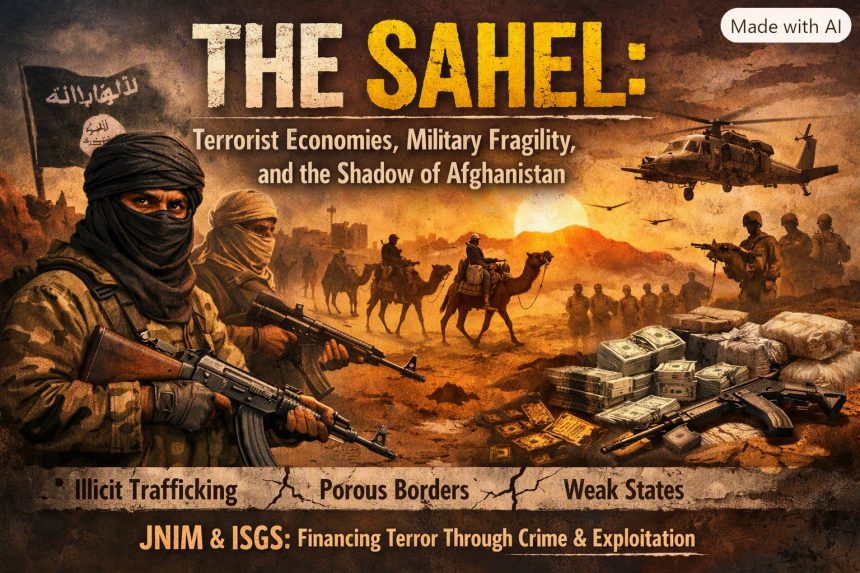
Terrorism in the Sahel is not only about ideology or religious extremism. It is rooted in economics. Groups such as Jama’at Nasr al-Islam wal Muslimin (JNIM) and the Islamic State in the Greater Sahara (ISGS) have built self-financing criminal economies that make them resilient, adaptable and hard to defeat. These insurgents thrive on illicit trade networks that existed long before their rise, taking advantage of porous borders and weak state institutions.
Across rural communities, the groups impose levies on civilians, traders and pastoralists. In many areas they collect what they call “zakat” or protection fees. In doing so they mimic basic state functions while at the same time eroding the authority of the state.
The geography of the Sahel has turned it into a major hub for smuggling. Armed groups earn from trafficking drugs, arms and migrants across Mali, Niger and Burkina Faso.
In addition to smuggling, illicit mineral mining has become a critical revenue stream. Gold mining in Burkina Faso and Mali now provides significant funding. Insurgents either take direct control of mines or extort miners, building parallel economies outside state regulation. The problem is not confined to the Sahel. Evidence shows that banditry in Nigeria’s North West is being fueled by illegal mining in states such as Zamfara, Kebbi and even Sokoto.
Because of this economic base, insurgents can withstand military pressure. Even when commanders are killed or camps are destroyed, the financial networks survive and allow groups to regroup quickly. It is this resilience that explains why counterterrorism operations often record tactical wins but fail to achieve strategic defeat.
The situation has been worsened by the withdrawal of the so-called Alliance of Sahel States (AES) — made up of Mali, Burkina Faso and Niger — from the regional bloc, ECOWAS. The AES emerged as a bloc of military governments that promised to restore sovereignty and resist foreign interference. Yet the political foundations of these juntas have exposed their fragility, including the contradiction of depending on Moscow. Military rulers often justify postponing elections on security grounds, arguing that stability must come before democracy. The question is how long that argument can hold.
Over time, these juntas are losing legitimacy by the day. The coups were initially welcomed by populations frustrated with civilian governments. Now citizens are concluding it was a case of the kettle calling the pot black, as repeated election delays continue. It is no longer in doubt that many people now view the military rulers as self-interested actors clinging to power.
Elections also present a security paradox. By using insecurity as a reason to delay polls, juntas unintentionally highlight their failure to provide stability. Every terrorist attack becomes further proof of that shortcoming.
At present, the AES juntas face international isolation. Sanctions and strained relations with ECOWAS and Western partners have limited economic growth and further weakened the regimes. While partnerships with Russia’s African Corps offer short-term military support, they do not address governance deficits.
The longer elections are postponed, the more politically exposed these juntas become. Their survival depends not only on military strength but also on public trust, a resource that continues to decline as violence persists.
Why JNIM always appears one step ahead
Despite the presence of foreign partners, including Russia’s African Corps, JNIM continues to show tactical superiority. Several factors explain this.
First is local intelligence networks. JNIM embeds itself in communities and uses kinship ties and grievances to its advantage. This grassroots intelligence allows it to anticipate military movements and strike when conditions are favorable.
Second is mobility and adaptability. Unlike conventional armies, JNIM fighters move easily across borders, exploit terrain and avoid static defense lines. Their decentralized command structure also makes them difficult to target.
Third is psychological warfare. By attacking symbolic targets such as military convoys or government officials, JNIM magnifies the perception of state weakness. Even small-scale attacks can have a large political effect.
Finally, JNIM exploits the presence of foreign forces. The arrival of Russia’s African Corps has not deterred the group. Instead, insurgents use propaganda to portray foreign soldiers as occupiers, stirring local resentment and boosting recruitment.
JNIM’s ability to stay “one step ahead” reflects not just military skill but also political calculation. The group understands that insurgency is about perception as much as it is about firepower.
Is the Sahel becoming Africa’s Afghanistan?
The parallels between the Sahel and Afghanistan are clear. Both regions show how insurgents can administer territory, how states can lose control of rural areas, and how foreign interventions struggle to build lasting stability.
In many Sahelian villages, insurgents now provide dispute resolution, enforce contracts and regulate markets. This shadow governance fills the vacuum left by absent states, creating the paradox that insurgents are both feared and relied upon.
Governments in Bamako, Ouagadougou and Niamey still hold authority in their capitals, but they have ceded vast rural areas. Military patrols may temporarily retake territory, but without sustained governance, control quickly disappears.
Counterinsurgency campaigns often announce battlefield successes. Yet those victories rarely translate into durable political authority. Once troops withdraw, insurgents return, underscoring the limits of purely military solutions.
Foreign partners have also struggled. From France’s Operation Barkhane to Russia’s African Corps, international actors have invested heavily in the Sahel. But external forces cannot replace local governance. Without legitimate institutions, foreign military support risks becoming another form of dependency.
The comparison to Afghanistan is not rhetorical exaggeration. It is a warning. Just as the Taliban outlasted international coalitions, Sahelian insurgents may endure unless governance, development and legitimacy are prioritized alongside military action.
The path ahead
The Sahel’s crisis has many dimensions. Terrorist groups sustain themselves through illicit economies, making them resistant to conventional military campaigns. Military juntas in the AES are losing legitimacy as they postpone elections under the cover of insecurity.
JNIM’s tactical agility ensures it remains a formidable adversary, even against foreign forces. And the broader trajectory increasingly resembles Afghanistan, where insurgents govern territory while states lose control in rural areas.
Moving forward will require more than weapons and foreign troops. It will require rebuilding trust between states and citizens, investing in governance, and dismantling the economic lifelines that sustain insurgents. Without those steps, the Sahel risks becoming a permanent theater of instability, a reminder that terrorism is not fought only on battlefields, but also in markets, villages, and in the fragile social contracts that hold nations together.
Amajama, a social and policy analyst, writes from Abuja and can be reached via amajamaip@gmail.com