









By Ipole Amajama
Russia’s decision to convene a third Russia-Africa Summit in October should be viewed with considerable skepticism. While Moscow presents the gathering as evidence of “true partnership” and a commitment to African development, the summit increasingly appears designed to serve a different purpose: to shore up Russia’s international legitimacy at a time when its conduct in Ukraine faces growing scrutiny and to distract attention from its limited economic delivery and questionable security record across Africa.
The timing is especially significant. Since launching its invasion of Ukraine in 2022, Russia has become increasingly isolated from Western markets and institutions. Faced with sanctions, diplomatic pressure, and criticism over military operations that have increasingly impacted civilian infrastructure, Moscow has sought alternative diplomatic platforms where it can project an image of global relevance and support. The Russia-Africa Summit offers precisely that opportunity.
Rather than being a forum defined by measurable development outcomes, the summit risks becoming a geopolitical stage where photographs, declarations, and speeches substitute for real progress. African leaders should ask a simple question: after two summits, hundreds of agreements, multiple commissions, councils, secretariats, and partnership forums, what tangible transformation has occurred?
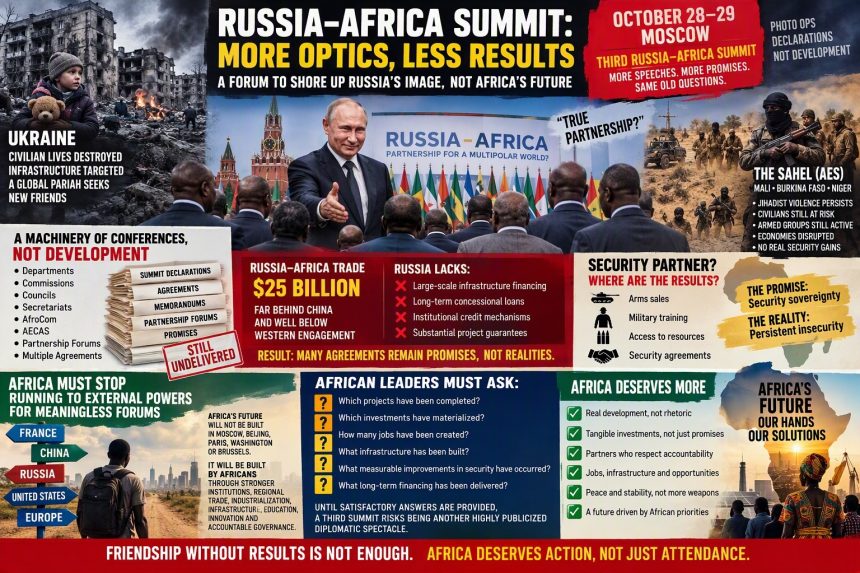
The answer is remarkably limited; a machinery of conferences, not development. Moscow has an impressive collection of Russian institutions dedicated to Africa: the Department of Sub-Saharan Africa, the Russia-Africa Partnership Forum Secretariat, multiple councils, AfroCom, AECAS, Joint Intergovernmental Commissions, and numerous trade sections in diplomatic missions. Yet despite this sprawling bureaucracy, Russia’s economic footprint in Africa remains weak.
Russian trade with Africa reached approximately $25 billion, still far behind China and significantly below broader Western engagement. More importantly, Russia lacks the institutional financing mechanisms that enable genuine development partnerships. Unlike China’s policy banks or Western development finance institutions, Russia cannot provide large-scale infrastructure financing, long-term concessional loans, or substantial project guarantees.
As a result, many agreements signed at previous summits remain promises rather than realities. Africa does not need another summit declaration. It needs roads, power generation, ports, manufacturing facilities, digital infrastructure, and jobs. Russia has demonstrated limited capacity to provide these at scale.
Perhaps the most glaring contradiction is Russia’s claim to be a reliable security partner. Russia’s engagement in Africa has been disproportionately concentrated in military cooperation, arms sales, security training, and access-to-resources arrangements. Yet the countries’ most closely associated with Russian security assistance continue to face severe instability.
The Alliance of Sahel States (AES), comprising Mali, Burkina Faso, and Niger, was presented by many proponents of Russian engagement as an alternative security architecture free from Western influence. Yet jihadist violence remains rampant across the region.
This raises a fundamental question: What security guarantees has Africa actually received? If Russian security partnerships are intended to stabilize fragile states, where are the results? Large areas of the Sahel remain contested by Islamist insurgent groups. Civilian casualties continue. Armed groups maintain freedom of movement. Economic activity remains disrupted. Millions remain vulnerable.
It is imperative to make the point that the promise was security sovereignty, but the reality has often been persistent insecurity. If Moscow cannot demonstrate clear security gains in the very countries where its influence is strongest, then African governments should be cautious about accepting Russian narratives regarding stability and partnership.
Russia’s claims of supporting peace, sovereignty, and development abroad are further weakened by its conduct in Ukraine. A country that speaks of partnership while simultaneously prosecuting a destructive war faces an unavoidable credibility problem.
The summit is likely to feature rhetoric about multi-polarity, anti-colonial solidarity, and respect for sovereignty. Yet many observers will note the contradiction between those messages and Russia’s military actions in Ukraine. African states, many of which emerged from long struggles against domination and external interference, should be especially alert to inconsistencies between rhetoric and behavior.
The central concern is not whether Russia seeks influence, every major power does. The concern is whether African governments are being asked to overlook uncomfortable realities in exchange for symbolic diplomatic engagement. The summit thus risks functioning as a reputational exercise, allowing Moscow to showcase attendance by African leaders as evidence that it remains a respected global actor despite growing international criticism.
For decades, African governments have repeatedly been told that their development depends on partnerships with external powers. First Europe. Then France. Then the United States. Then China. Now increasingly Russia. The pattern remains remarkably similar.
African leaders attend summits, sign declarations, announce strategic partnerships, and celebrate new eras of cooperation. Yet structural challenges persist across much of the continent. The problem is not engagement with foreign countries. International cooperation remains essential. The problem is dependency on external powers as the primary drivers of development.
Africa’s economic sovereignty will not emerge from Moscow, Beijing, Paris, Washington, or Brussels. It will emerge from stronger domestic institutions, regional trade, industrialization, infrastructure investment, educational advancement, technological innovation, and accountable governance.
After two Russia-Africa summits, African leaders should demand evidence: Which projects have been completed?
Which investments have materialized? How many jobs have been created? What infrastructure has been built? What measurable improvements in security have occurred? What long-term financing has been delivered?
Until satisfactory answers are provided, a third summit risks becoming what the first two often appeared to be: a highly publicized diplomatic spectacle producing declarations that far exceed results.
Africa deserves more than geopolitical courtship. It deserves partners that deliver measurable development, respect accountability, and offer tangible benefits rather than symbolism.
The question facing African leaders in Moscow is therefore not whether Russia is a friend. Rather, it is whether friendship without results is enough. Based on the evidence so far, the answer should be no.
Amajama, a social and policy analyst, writes from Abuja and can be reached via amajamaip@gmail.com
