






By Abdullahi Alhassan, Kaduna
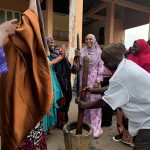
For one day, the market town known for past ethno-religious clashes chose pounding boards over protest, and shared meals over suspicion, as residents marked the International Day of Peace on Monday.
The Interfaith Mediation Centre, with backing from the German Embassy in Abuja, organized the commemoration around a simple idea: that trust in Kasuwan Magani will not be rebuilt in meetings alone, but in kitchens, playgrounds and around elders.
The Kaduna community has long been a melting pot for traders of different faiths and ethnic groups. It has also been a flashpoint where violence destroyed livelihoods and left deep scars. This year, IMC deliberately put culture and women in front.
“Peace cannot grow where people are divided by identity,” said IMC Co-Executive Director, Mr. Samson Auta. “If there is peace, there can be development. If there is interaction, there will be understanding.”
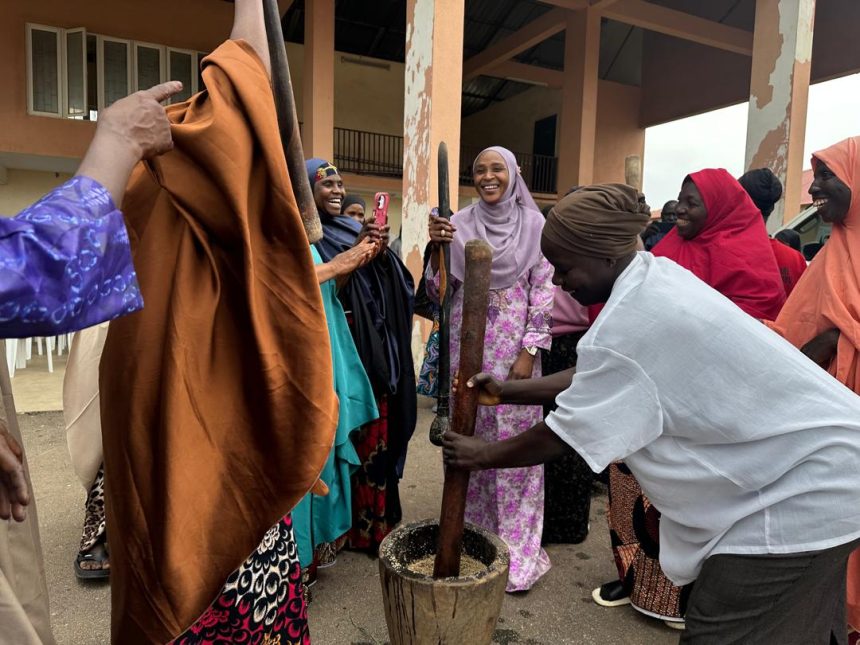
Residents spent the day cooking local dishes together, reviving the pounding and grinding of guinea corn, and playing traditional games. The target audience was clear: young people who, organizers say, are growing up disconnected from the customs that once bound Christians and Muslims in the area.
“People are not connected to their history, people are not connected to their culture,” Auta warned. “We need to revisit this culture to teach our younger ones so that we just don’t lose our identity. Because when we lose our identity, we don’t know where we are.”
IMC said the model is already expanding to Zone 1 and Zone 3 of Kasuwan Magani, with the goal of making peacebuilding a daily practice, not just an annual event.
Community leader Jonathan Peter said the approach was a response to a gap left by modern education.
“We have relied too much on Western education and lost the values of togetherness,” Peter said. “Elders must now teach the next generation how to live together.”
He said women are at the heart of that effort.
“Women are critical to child upbringing and to achieving lasting peace,” he noted. “That is why we are focusing on activities that strengthen relationships among women.”
Peter also challenged the Federal Government to do more to rebuild national trust, and called on the Christian Association of Nigeria and Jama’atu Nasril Islam to work together in good faith.
“Humanity comes before any religion,” he said.
He added that traditional rulers must be given a bigger role because their influence cuts across political, religious and tribal lines.
“Unlike religious bodies that operate within limited mandates, traditional institutions have no boundaries and remain rooted in the core purpose of uniting people,” he said.
Residents who participated said the day felt familiar.
“My call to young ones is for us to reflect on what our olden days parents were doing, because there was no segregation between Christian and Muslim,” said Miss Gift Jerry. “They always do things together, they play together, they come together as one. When we see what our parents have been doing before, we reflect, then we will be able to follow their steps and do more.”
IMC described the event as part of broader work to heal divisions and entrench peaceful coexistence by returning to values passed down by previous generations.
The takeaway from Monday was direct. In a town once defined by conflict, organizers said peace is starting again with something as ordinary as a pot, a mortar, and neighbors deciding to sit together.
